

Vintage Japanese Kutani Pottery Dish, Aka Midori Glazed Ceramic Plate, Edo Meiji Era, Red Green Enamel, Collector Antique, Wood Stand Included
$999.00
Skip to product information




Vintage Japanese Kutani Pottery Dish, Aka Midori Glazed Ceramic Plate, Edo Meiji Era, Red Green Enamel, Collector Antique, Wood Stand Included
$999.00
Listing hoàn chỉnh — Vintage Kutani Aka-Midori Dish
ETSY TITLE (140 chars max)
Vintage Japanese Kutani Pottery Dish, Aka Midori Glazed Ceramic Plate, Edo Meiji Era, Red Green Enamel, Collector Antique, Wood Stand IncludedTAGS (13 tags)
japanese kutani dish
vintage ceramic plate
aka midori pottery
edo period ceramics
japanese antique dish
red green enamel art
collector japanese art
asian ceramic decor
meiji era pottery
japanese gift luxury
wabi sabi home decor
antique display plate
japanese dining decor
FULL DESCRIPTION
WHAT YOU'RE GETTING
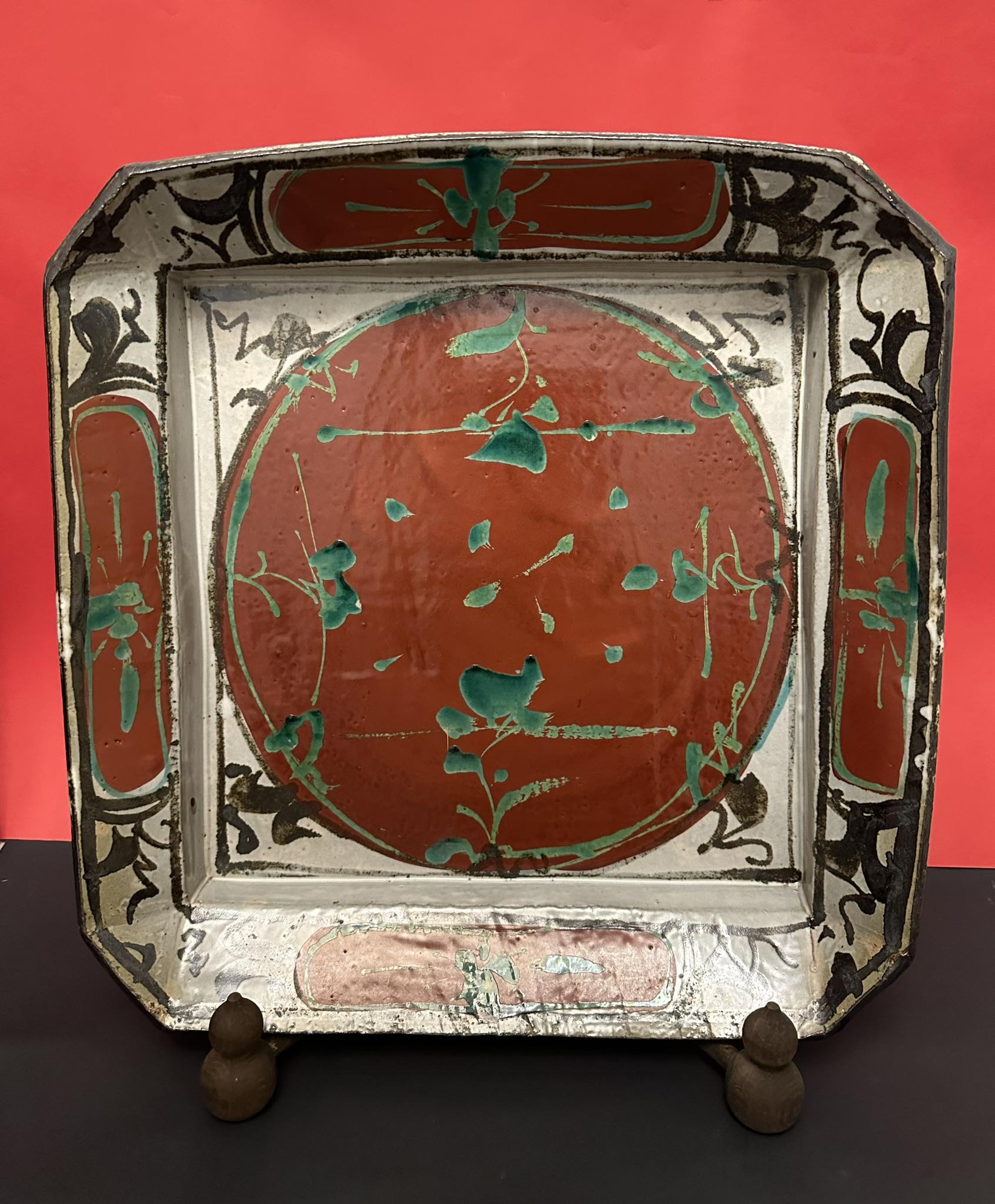
A rare vintage Japanese Kutani (九谷焼) ceremonial dish in the classic Aka-Midori (赤緑 — Red-Green) palette, accompanied by its original hardwood display stand with hand-carved double-gourd (hyōtan) feet. This is a complete set — dish and stand together — exactly as it would have been displayed in a Japanese tokonoma alcove or formal reception room.
The dish is octagonal-square (kakuzara — 角皿) with chamfered corners, painted in iron-red (bengara) and copper-green (rokushō) enamel over a white-silver glaze ground. The central motif is a large iron-red circle — the sun, eternity, or simply the perfection of the round — scattered with free-flowing green botanical brushwork of extraordinary spontaneity. The border carries four cartouches in iron-red with green decoration, separated by bold black cursive scrollwork on white. Along the side rim, the auspicious characters 福壽 (Fuku-ju — Fortune and Longevity) are painted in red in flowing grass script — confirming this piece was made for a significant celebratory occasion.
PROVENANCE & ATTRIBUTION
No maker's mark (無款 — mukan) is present on the base, which is typical of Kutani ware from the Edo period, when master potters often worked without formal seals. The clay body — a distinctive warm terra-cotta pink, fully unglazed on the reverse — is characteristic of Kaga Province earthenware (present-day Ishikawa Prefecture), the historical home of Kutani production. Surface bubbling in the iron-red enamel, visible under magnification, is consistent with hand-application at variable kiln temperatures — a hallmark of pre-industrial Edo firing technique.
Estimated period: Late Edo to Early Meiji — circa 1780–1870.
THE DISPLAY STAND
The original hardwood stand is a remarkable artifact in its own right. Two tapering cylindrical uprights in dark rosewood or zelkova (keyaki) are joined by a hand-forged iron hinge with visible hand-driven screws — the iron showing deep, even rust patination that has spread into the wood grain, confirming authentic age. The feet are carved in the form of the double gourd (hyōtan — 瓢箪), one of Japan's most beloved auspicious symbols, associated with longevity, good fortune, and the warding of evil. A cross-bar at the base with matching gourd-form finials completes the composition. This stand was made for this dish — or for a piece of identical dimensions — and the two have clearly spent their lives together.
CONDITION
Honest vintage condition consistent with approximately 150–200 years of age and display:
- Enamel chipping and loss at rim edges — characteristic of handling over generations
- Surface crackle throughout white glaze — natural and expected
- Iron-red and green enamel remain vivid and intact across the main decorative field
- Base unglazed and clean — no repairs, no restoration
- Stand: iron hinge with authentic rust patination; wood surface shows natural aging with no cracks or breaks
This piece has not been restored. What you see is original.
DISPLAY & STYLING
Mount on the included stand in a tokonoma alcove, on a mantelpiece, sideboard, or as a centerpiece on a low table. The red-green-white palette is bold enough to anchor a room and refined enough to suit a collector's study or a modern interior seeking authentic cultural depth. Pairs naturally with sumi-e ink paintings, bronze objects, lacquerware, and natural textile backgrounds.
FOR THE COLLECTOR
Kutani Aka-Midori dishes of this scale and palette are increasingly difficult to source outside Japan. The combination of iron-red ground, free botanical brushwork, auspicious calligraphy on the rim, mukan base, and pink terra-cotta clay body places this firmly in the Edo-Meiji transition period — a window of Japanese ceramic production that preceded industrialization and represents the last generation of purely hand-made Kutani. Acquiring this piece with its original display stand is exceptional — stands of this quality are rarely found with their companion pieces intact.
Dimensions
Diameter: 39 cm (15.4 in) Height: 6 cm (2.4 in)
